

If you’re asking “what boxing gloves size should I get?” the answer depends less on charts and more on how you actually train.
Boxing glove weight (oz) tells you one simple thing: how the glove behaves when you train.
It affects how hard you hit, how fast you fatigue, and how much feedback your hands and wrists get.
It does not tell you how ‘good’ a glove is. It does not tell you if it will protect your hands or wrists. And it does not tell you if it’s right for your style of training.
If you remember one thing, remember this: ounces measure total glove weight, not padding thickness and not hand size.
Glove weight is not a badge of quality. It is not a promise of protection. It is a design constraint that affects how the glove absorbs impact, how it distributes fatigue through the arms, and how much feedback the athlete receives round after round. Understanding that is the difference between choosing gloves that support your training, and choosing gloves that quietly work against it.
What “oz” actually refers to
The ounce (oz) rating refers to the total weight of the glove, not simply the amount of padding over the knuckles. In practical terms, the number includes everything: padding, lining, wrist support, straps, and outer material.
This matters because glove weight tells you only one thing with certainty: how heavy the glove is in your hand. It does not tell you where that weight sits. Two 14oz gloves can feel completely different if one carries more mass at the wrist and another carries it through the knuckle padding. The ounce rating is a starting point, not a full description.
You don’t need a chart or a video to understand this. You feel it once fatigue sets in.
Why glove weights became standard
Glove weight wasn’t created to help boxers choose their boxing gloves. It exists to control risk.
For example:
- IBA specifies 10oz gloves in lighter men’s categories and 12oz in heavier men’s categories; it also defines glove weight tolerances in grams. (See IBA Technical & Competition Rules, glove specifications.)
- USA Boxing requires 16oz gloves for all weight categories in certain matched-bout contexts (as stated in its rule book equipment section).
- England Boxing rulebooks include guidance where 14oz may be permitted up to a weight threshold and 16oz above in specific settings, provided both boxers wear the same weight.
The important point is not that every rule is identical (they are not). The point is that glove weight exists in boxing culture because it is a practical safety tool.
Once you understand that, training choices stop being confusing.
Heavier gloves: what they help with (and what they hide)
Heavier gloves generally mean more total mass and, often, more padding volume. That can reduce peak impact forces in repeated contact. This is why many gyms and rulebooks converge on 16oz as a sparring standard: it reduces cumulative damage and makes rounds safer for both athletes.
But heavier gloves also do three things that are often ignored:
- They increase fatigue. More mass on the end of the arm changes how quickly shoulders and forearms tire. Late-round technique often breaks down in heavier gloves.
- They soften feedback. The glove can absorb errors that would be obvious in a lighter glove. Misalignment can feel “fine” until it isn’t.
- They change timing. A heavier glove moves differently. If all your training happens in one weight, it can subtly shape your rhythm.
So yes, heavier gloves can be safer in sparring. But used as your main training gloves for pads and heavy bag, can also hide problems that need correction.
Lighter gloves: what they reveal (and why that’s useful)
Lighter gloves are often described as “faster”, but that’s not the reason you would choose them. The main benefit is clarity.
With less mass and less padding volume, you will get cleaner feedback on:
- knuckle alignment
- wrist position
- accuracy on the target
- how the glove behaves on impact
That feedback is valuable in bag work and pad rounds where the goal is technical improvement, not controlled contact with another fighter. The risk with lighter gloves is not that they are “bad”; it’s that they demand more discipline in technique and workload. If you do long, high-volume bag sessions with very light gloves and poor alignment, you can aggravate hands and wrists unnecessarily.
How to choose glove weight for training: clear guidance
Below is a practical way to choose without turning it into a chart obsession. Think in terms of what your training is made of most weeks.
1) Mostly bag work
Typical range: 12oz–14oz for many adults, depending on intensity and hand comfort.
Why: Bag work benefits from ‘hearing’ feedback from your gloves and managing fatigue. If you go too heavy, you’ll feel it in your shoulders the next day. Too light, and cumulative impact may be harsh over time.
Rule of thumb: If bag work is your main training, choose a glove that keeps your technique clean ‘on form’ in later rounds. The “best” weight is the one you can still punch correctly in after you’re tired and your form is about to break.
Bag work is where feedback matters more than protection.
2) Mostly pads and technical rounds
Typical range: 8oz–12oz for speed and feedback, sometimes 14oz if you prefer more protection or do higher volume.
Why: Pads are about timing, accuracy, and repetition. Lighter gloves tend to transmit clearer feedback and keep the hands quick. Coaches often prefer athletes to feel what they are doing rather than having it absorbed by excess padding.
Rule of thumb: Choose the weight that helps you stay accurate, not the one that feels impressive on your hands.
3) Regular sparring
Typical range: 14oz–16oz is the standard in many gyms; sometimes heavier for very heavy athletes or hard sparring cultures.
Why: Sparring is the one training style where impact reduction and safety are the priority, and this is reflected in how many governing bodies and gym rules treat glove weight. The goal is not maximum feedback; it is controlled contact with reduced risk.
Non-negotiable principle: Always follow your gym’s sparring rules. If the gym mandates 14oz, treat that as part of the safety system.
4) Mixed training (bag + pads + some sparring)
This is where most people get stuck. The honest answer is that one glove will always be a compromise if you do everything.
Practical approach:
- Use a minimum of 14oz for sparring (if you spar).
- Use 8oz–14oz for most bag/pad work depending on intensity and comfort.
If you only want one pair initially and sparring is occasional, 14oz is often the “least wrong” compromise for many adults. But if you spar regularly, own the reality: sparring gloves should be sparring gloves.
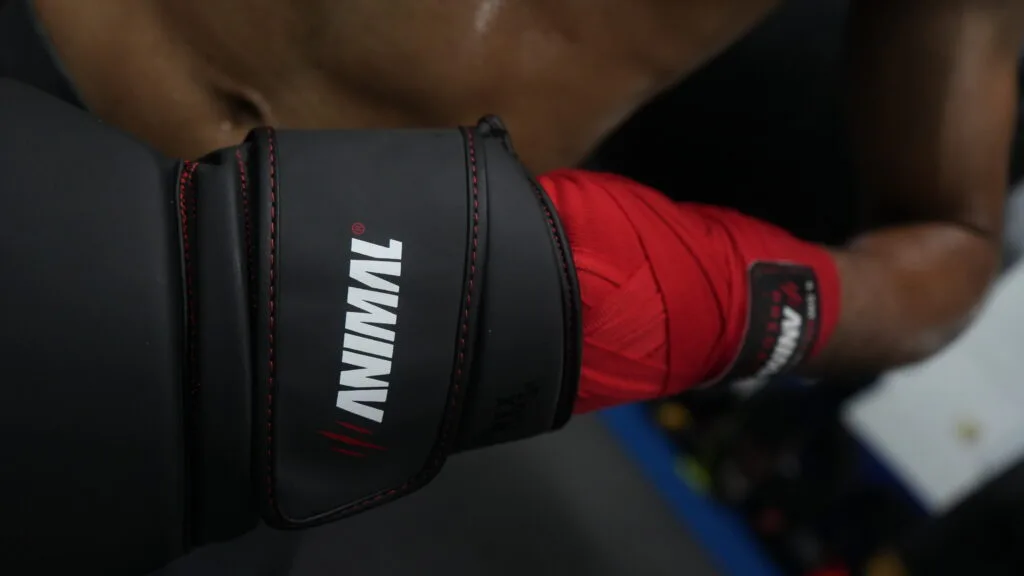
Some gloves are built with a narrow purpose in mind, while others are designed to cover a broader range of training contexts. The Predator Series Boxing Gloves fall into the latter category, with proportions and padding intended to remain usable across varied training sessions.
Why glove weight alone does not account for hand size
One of the most common sources of confusion around glove weight is the assumption that ounces directly correlate to hand size. In practice, they do not.
An 8oz glove does not represent a universal internal size. The way that space is allocated inside the glove depends heavily on the type of glove and its intended use.
Competition-style leather lace-up gloves are typically built with a tighter internal cavity. Their purpose is to provide a precise, compact fit that promotes accuracy and wrist alignment under regulated conditions. An 8oz lace-up competition glove is therefore designed to fit a relatively small hand, often snug even on an average adult male hand.
Training gloves, even at the same ounce rating, are constructed differently. They usually feature a larger internal hand compartment to accommodate hand wraps, repeated use, and a wider range of users. As a result, an 8oz training glove will often feel noticeably roomier than an 8oz competition glove.
This is why an 8oz training glove may fit a small adult male hand comfortably, while the same weight in a professional lace-up glove may feel restrictive. It is also why lighter training gloves are sometimes more suitable for juniors or athletes with smaller hands, even though the ounce number appears low.
The key point is this: glove weight tells you how heavy the glove is, not how much space your hand will have inside it.
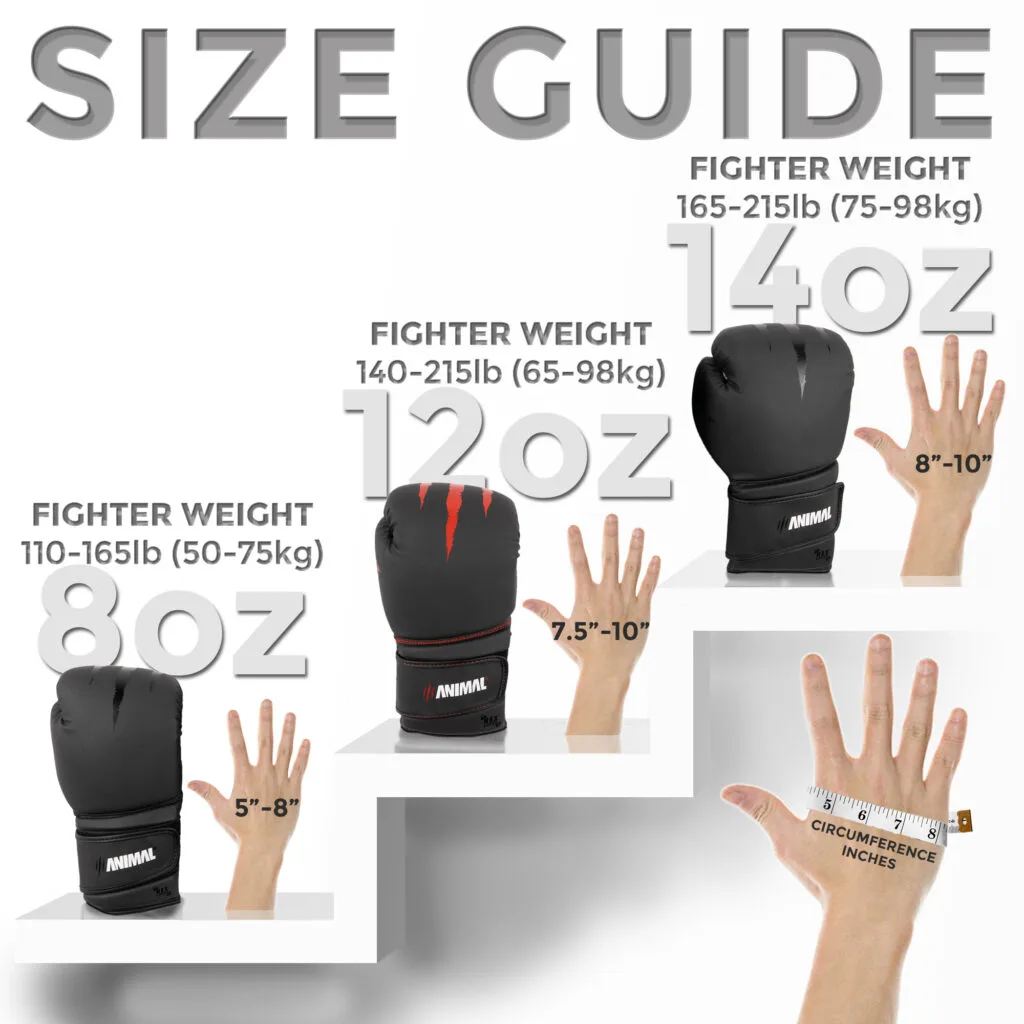
The size guide shown here helps visualise why ounce weight alone is an incomplete measure, as gloves of the same weight are designed around different hand circumferences and use cases.
Women’s boxing gloves: design differences and weight considerations
Women’s boxing gloves are not simply smaller versions of men’s gloves. Well-designed women’s gloves account for differences in hand volume, finger length, palm width, and wrist taper.
On average, female hands tend to have slimmer palms, shorter finger lengths relative to palm size, and narrower wrists. When standard unisex gloves are scaled down only by weight, these proportions are often ignored. The result can be gloves that feel bulky in the fingers, unstable at the wrist, or awkwardly balanced.
Purpose-designed women’s gloves typically address this by:
- Reducing internal hand volume without overly shortening finger length
- Improving wrist taper so the glove stabilises without excessive tightening
- Redistributing padding so the glove does not feel front-heavy on smaller hands
In terms of weight, many women find that 8oz–10oz training gloves provide the best balance between protection and control for bag and pad work, depending on hand size and training intensity. For sparring, the same safety principles apply as for men: gyms often require 14oz or 16oz gloves, regardless of gender, to manage impact during contact, however 10-12oz gloves are still allowable for sparring for females to accommodate the difference in strength and fitting, as 16oz can feel oversized in many glove designs for females.
The important consideration is not the label, but the fit. A glove that matches hand proportions will feel more stable, reduce unnecessary forearm fatigue, and allow technique to remain consistent deeper into sessions.
Choosing glove weight without considering hand size and shape often leads to gloves that technically “fit” but never feel settled in use. When the internal geometry matches the athlete, the glove becomes less noticeable which is exactly how it should be.
What glove weight does not tell you
This is where many athletes waste money. They see the ounce number and assume it guarantees protection or longevity. It does not.
Glove longevity and safety depend heavily on:
- padding behaviour (does it compress evenly and predictably?)
- wrist structure (does it stabilise without forcing a false position?)
- construction (stitching, stress points, liner quality)
- materials (how the outer ages under sweat and friction)
This is why glove weight should be treated as a tool, not a conclusion.
A simple decision framework (so you leave with an answer)
If you want a simple way to decide, ask yourself these questions in order:
- Do you spar regularly? If yes, you need a sparring glove weight (usually 14oz min) that matches your gym rules.
- What is most of your week? Bag-heavy, pads-heavy, or mixed? Choose a training glove weight that supports that majority and obviously one that fits your hand size.
- Do your hands or wrists get sore? If yes, don’t instantly go lighter or heavier. First check technique and wrist support. Then adjust weight if needed.
- Can you keep form late in the session? If not, your glove may be too heavy for the work you’re doing (or the session volume is too high for your current conditioning).
The “best” glove weight is the one that keeps your training honest: enough protection to manage volume, enough feedback to keep technique accountable, and enough comfort to avoid compensation.
Equipment should clarify training, not complicate it. Glove weight stops being confusing when it’s treated as what it is: a design choice, used for specific contexts.
Sources
- England Boxing Rule Book (glove weight guidance in certain settings): PDF
- England Boxing 2025 Rule Book (latest published): PDF
- USA Boxing Rule Book (equipment section includes 16oz requirement in matched bouts): PDF
- IBA Technical & Competition Rules (competition glove weights and specs in grams/oz): PDF
- Thee Combat Corporation
This is exactly why I look forward to reading your posts every time 💯